
TLDR
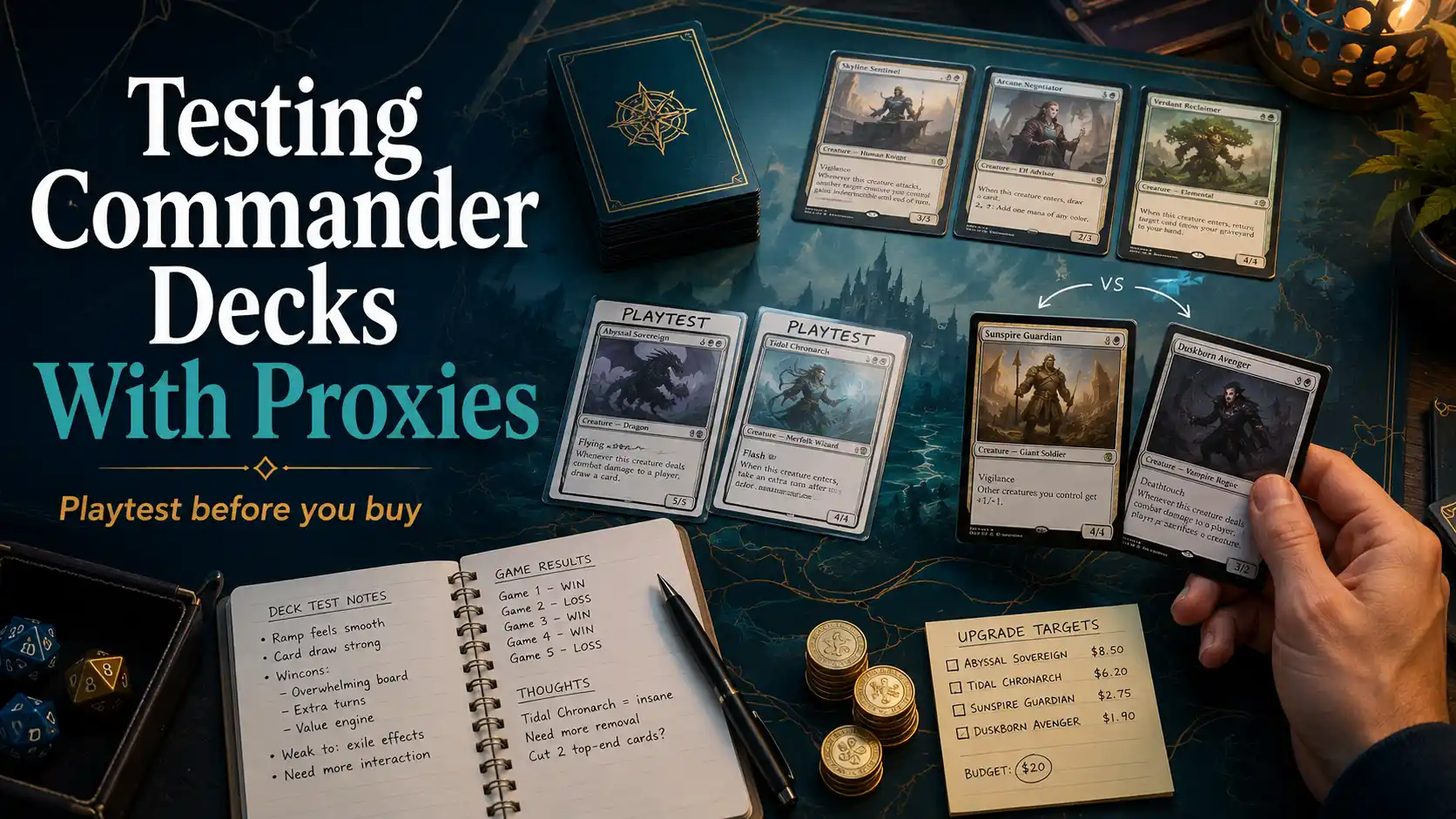
- MTG proxies are best used as playtest cards before you commit money to expensive Commander upgrades.
- Start by testing cards that answer a real deckbuilding question, not every strong card you can think of.
- Tell your pod before the game, keep proxy cards readable, and avoid surprising people with a much higher-power deck.
- Track whether each proxy actually improves your deck, then decide whether to buy, cut, or keep testing.
Buying the wrong Commander card feels bad in a very specific way. You sleeve it up, draw it twice, realize it does not fit your deck, and then quietly move it to the “maybe someday” box. The box grows. The lesson repeats.
That is the practical reason to learn how to use MTG proxies to test a Commander deck before buying cards. Proxy cards are not just a budget workaround. Used well, they are a deckbuilding tool. They let you test mana bases, expensive staples, narrow combo pieces, and splashy finishers before you spend money on cards your deck may not even want.
The key phrase is “used well.” A pile of random proxies can make testing messier, not clearer. But a small, honest testing plan can tell you a lot. Does this tutor make the deck too consistent? Does this shock land actually matter? Does this seven-mana finisher end games, or does it sit in your hand while everyone else does useful things?
That is what we are solving here.
Why MTG Proxies Work So Well for Commander Deck Testing
Commander is a strange format for card buying because the cards are not only judged by raw power. A card can be strong and still be wrong for your deck. Another card can look mediocre until your commander turns it into the exact piece you needed.
That is why MTG proxies are useful. They let you test the card in the real context: your commander, your mana base, your curve, your playgroup, and your normal pace of games.
A proxy, in this context, is a stand-in card. It should be clear, readable, and obvious to everyone at the table. It is not a counterfeit. It is not something you pass off as real. For casual Commander testing, the clean version is simple: “I’m testing these cards before buying them. Are you good with that?”
For sanctioned events, treat proxies differently. Official tournament play has its own card legality rules, and player-made proxies are not the same thing as legal tournament cards. This article is about casual Commander deck testing, not using proxies where they are not allowed.
How to Use MTG Proxies to Test a Commander Deck With a Clear Plan
The best way to use MTG proxies to test a Commander deck is to start with one question.
Not ten questions. Not “what if I rebuilt the whole deck with a pretend unlimited budget?” One question.
Try these:
- Is my mana base good enough for a three-color deck?
- Do I need another board wipe?
- Is this expensive staple actually better than my current card?
- Does this combo piece improve the deck, or does it make games less fun?
- Is this new commander worth building around?
That question gives the test a shape. Without it, you end up proving that good cards are good, which is true but not very helpful.
A simple testing note can look like this:
Card being tested: Teferi’s Protection
Card being replaced: Heroic Intervention
Question: Is the extra protection worth the higher price and white requirement?
Result after three games: Saved the board once, sat dead once, was win-more once.
That tells you something. You may still buy the card. You may not. But now the choice is based on games, not vibes and forum confidence.
Start With Expensive Staples, Mana Bases, and Narrow Upgrades
Do not proxy random cards just because they are famous. Proxy cards that could change a real purchase decision.
The best candidates usually fall into four groups.
First, test expensive mana base pieces. Lands are some of the easiest cards to overbuy because they feel universally safe. And many are strong. But your actual deck may not need every premium land right away. A two-color deck, a green ramp deck, and a low-curve three-color deck do not ask the same things from a mana base.
Shock lands are a clean example. They are strong because they can enter untapped and have basic land types. But before buying into a full package, it helps to understand which ones matter for your colors and fetch patterns. The existing list of shock lands in MTG is a good companion piece for that part of the process.
Second, test format staples that may raise your deck’s power level. Tutors, fast mana, free interaction, and hyper-efficient protection can change how a deck plays. Sometimes that is the point. Sometimes it turns a fun mid-power list into something your normal table did not sign up for.
Third, test commander-specific cards. These are the cards that look bad everywhere else but perfect in your list. They are often harder to evaluate by reading. You need to draw them, cast them, and see whether they solve an actual problem.
Fourth, test narrow finishers. Big splashy spells are seductive. Commander players are only human. But an eight-mana “win the game eventually” card needs to do real work. Proxy it first and see how often it gets stranded.
Use Proxies to Test Your Mana Base, Not Just Spells
Mana testing is less exciting than testing a new dragon, but it may win more games. Or at least prevent more games where you stare at three lands and four uncastable spells like your deck is making a personal attack.
When testing mana with proxies, watch for practical problems:
- Can you cast your commander on time?
- Are you missing one color too often?
- Do too many lands enter tapped in the first three turns?
- Are pain lands, fetch lands, shock lands, or triomes actually improving the opening turns?
- Are you taking too much damage from your own lands in aggressive pods?
The point is not to build the most expensive mana base possible. The point is to build the mana base your deck needs.
For a casual two-color Commander deck, a perfect mana base may be unnecessary. For a three-color deck with early colored pips, the difference between “fine” and “actually good” is much larger. Proxy testing helps you find that line before you buy cards that may only improve the deck on paper.
Talk to Your Pod Before the Game Starts
Proxy testing works best when nobody feels ambushed.
A quick pregame note is enough most of the time:
“I’m testing six proxy cards in this deck before buying them. They’re all readable, and nothing is meant to push the deck past our usual power level.”
That sentence does a lot. It tells people what is happening, how many cards are involved, and what kind of game you are trying to play.
For higher-power tests, be more direct:
“This version has proxy fast mana and a couple tutors. It is probably stronger than the normal build. Is this the kind of game we want right now?”
That is not overexplaining. That is basic table maintenance. Commander already runs on expectations. Proxies just make those expectations more important because they can remove normal budget limits.
The awkward part is not using proxies. The awkward part is acting like proxies do not change anything when they clearly do.
Run Three Kinds of Test Games
One game is not enough. Commander has too much variance. You can draw the proxy at the wrong time, get mana screwed, get targeted early, or win before the test card matters.
A better testing plan uses three types of games.
Goldfish Games
Goldfishing means playing opening turns by yourself with no opponents. It is not a real game, but it is useful for mana and curve testing.
Use goldfish games to answer simple questions:
- How often do you keep opening hands?
- Can you cast early ramp and setup spells?
- Does the deck have too many tapped lands?
- Does the proxy card fit naturally into the curve?
This is not where you decide whether a card is fun. It is where you find obvious mechanical problems.
Normal Pod Games
Next, test in your usual playgroup. This matters because your pod has its own pace. Some tables durdle. Some tables punish slow starts. Some tables let engines live. Some tables kill every commander on sight and call it friendship.
Normal games tell you whether the proxy card fits the environment you actually play in.
Stress Test Games
Finally, test against the thing your deck struggles with. If your deck loses to creature swarms, test against go-wide boards. If your deck folds to graveyard value, test against graveyard decks. If you are trying to decide how many sweepers you need, the existing post on why board wipes matter more in Commander is a useful related read.
Stress testing prevents false confidence. A card can look great in a slow, friendly game and still fail the moment the table applies pressure.
Track Results Without Turning Commander Into Homework
You do not need a spreadsheet unless you enjoy spreadsheets. And if you do, that is between you and your mana curve.
A small note after each game is enough:
- Did I draw the proxy?
- Did I cast it?
- Was it better than the card it replaced?
- Did it solve the problem I was testing?
- Did it make the game better, worse, or just different?
That last question matters in Commander. A card can improve your win rate and still make your deck less enjoyable for your table. That does not mean you can never play it. It just means you should be honest about what the card does to the experience.
A good proxy test gives you one of four outcomes:
- Buy the card because it clearly improves the deck.
- Skip the card because it did not perform.
- Keep testing because the sample size is too small.
- Rebuild the deck because the test revealed a bigger issue.
That fourth result happens more often than people expect. Sometimes the problem is not the one expensive card you do not own. Sometimes the problem is your curve, ramp, card draw, or threat density. Proxies can expose that quickly.
Common Mistakes When Testing Commander Proxies
The first mistake is proxying too many cards at once. If you swap in 25 proxies, you are not testing upgrades anymore. You are testing a different deck. That can be fine, but call it what it is.
The second mistake is only testing cards when you are ahead. A good Commander card should often be useful when you are behind, stable, or trying to close. If a proxy only looks good when everything is already working, it may be a luxury slot.
The third mistake is ignoring replacement cost. The new card does not just need to be good. It needs to be better than the card you cut. Commander decks are full of “pretty good” cards. The hard part is making the last ten slots honest.
The fourth mistake is hiding the ball on power level. If your proxy package adds Mana Crypt-style acceleration, premium tutors, and free interaction, your deck may not belong in the same game it did last week. That is not a moral failure. It is just something the table should know.
The fifth mistake is treating online opinions as final. Commander advice is useful, but your deck is local. Your pod, pace, budget, and tolerance for certain play patterns matter.
A Simple Proxy Testing Framework
Use this framework when you are unsure where to start:
- Pick one deckbuilding question.
- Choose three to eight proxy cards that relate to that question.
- Replace specific cards, not random flex slots.
- Tell the table what you are testing.
- Play at least three real games.
- Write one sentence after each game.
- Buy, cut, or keep testing.
That is enough structure for most Commander players. It keeps the test useful without turning a casual format into a lab report.
For example, say you are testing whether your Esper deck needs better interaction. You proxy three cards: Fierce Guardianship, Cyclonic Rift, and Toxic Deluge. You cut three existing interaction spells. After several games, you may find that Toxic Deluge fixes a real problem, Cyclonic Rift is strong but not needed, and Fierce Guardianship pushes the deck into a power band your table does not enjoy.
That is a successful test even if you only buy one card.
Final Thoughts
Learning how to use MTG proxies to test a Commander deck is really about slowing down before you buy. Commander rewards experimentation, but the secondary market does not refund you just because your “obvious upgrade” turned out to be clunky.
Start with a clear question. Test cards that matter. Keep the proxies readable. Talk to your pod. Then judge the cards by what they actually do in games.
Some cards will earn the purchase. Some will not. And occasionally, a proxy will teach you that your deck did not need a flashy upgrade at all. It needed two more lands and a cheaper draw spell. Not glamorous, but very Commander.
FAQs
Are MTG proxies legal in Commander?
In casual Commander, proxy use depends on the group, store, or event organizer. Ask before the game. Commander has a strong pregame conversation culture, so proxies should be discussed openly with power level, banned cards, and other expectations.
Can I use MTG proxies at FNM or sanctioned tournaments?
For sanctioned Magic events, use authentic legal Magic cards unless a judge issues an official tournament proxy for a narrow tournament-specific reason. Player-made proxy cards are for casual playtesting, not sanctioned tournament substitution.
How many proxies should I test at once?
For normal deck tuning, three to eight proxies is a good range. That is enough to compare upgrades without turning the deck into a completely different list. For a full rebuild, proxy more cards, but treat the session as a new deck test.
Should I proxy cards I do not own?
For casual testing, many groups allow players to proxy cards they are considering buying or trying. Some groups only allow proxies for cards a player already owns. There is no universal Commander table rule, so ask your group directly.
What should an MTG proxy card include?
At minimum, an MTG proxy should include the card name, mana cost, type line, rules text, power and toughness if needed, and anything else required to play clearly. The card should be easy to identify and should not be presented as authentic.
Do proxies make Commander decks too strong?
They can. Proxies remove budget as a deckbuilding limit, which can push a deck higher in power very quickly. That is why it helps to disclose proxy cards before the game and test upgrades in a way that matches the table’s expectations.