Category: Uncategorized

  • List of Shock Lands in MTG

    If you need a list of shock lands, here it is in plain English. Shock lands are the ten rare Ravnica dual lands that can enter untapped if you pay 2 life. If you do not pay, they enter tapped. Clean, efficient, mildly painful. Which, to be fair, describes a lot of Magic mana bases.

    What makes shock lands special is not just speed. Each one also has two basic land types, which means they work with fetch lands and other cards that care about Plains, Island, Swamp, Mountain, or Forest. That is why these lands keep showing up in serious mana bases instead of being remembered fondly for five minutes and then replaced by some new cycle with an overly cute nickname.

    The Full List of Shock Lands

    Here is the full list of shock lands in MTG:

    • Hallowed Fountain: White and blue. Land types: Plains Island.
    • Watery Grave: Blue and black. Land types: Island Swamp.
    • Blood Crypt: Black and red. Land types: Swamp Mountain.
    • Stomping Ground: Red and green. Land types: Mountain Forest.
    • Temple Garden: Green and white. Land types: Forest Plains.
    • Godless Shrine: White and black. Land types: Plains Swamp.
    • Steam Vents: Blue and red. Land types: Island Mountain.
    • Overgrown Tomb: Black and green. Land types: Swamp Forest.
    • Sacred Foundry: Red and white. Land types: Mountain Plains.
    • Breeding Pool: Green and blue. Land types: Forest Island.

    If you prefer the guild version, the same list lines up exactly with the ten Ravnica guilds. Azorius gets Hallowed Fountain. Dimir gets Watery Grave. Rakdos gets Blood Crypt. Gruul gets Stomping Ground. Selesnya gets Temple Garden. Orzhov gets Godless Shrine. Izzet gets Steam Vents. Golgari gets Overgrown Tomb. Boros gets Sacred Foundry. Simic gets Breeding Pool. Nice and organized. Ravnica loves paperwork.

    Why Shock Lands Matter

    Shock lands do three useful things at once.

    First, they fix two colors. Obvious, yes, but still important. If your deck needs two colors early and consistently, shock lands help it stop tripping over its own shoelaces.

    Second, they can come in untapped when tempo matters. Paying 2 life is often worth it when you need to hold up interaction, curve out, or just cast the spell in your hand instead of staring at it like it personally betrayed you. In slower games, you can let them enter tapped and keep your life total intact. That flexibility is a big reason the cycle aged so well.

    Third, they carry two basic land types. That is where things get spicy in the least glamorous way possible. Fetch lands can find them, and cards that check for basic land types treat them as the real thing for rules purposes. So shock lands are not just good dual lands. They are the kind of infrastructure that quietly makes the rest of your deck function like it had a plan all along.

    That combination is why shock lands have stayed relevant in formats like Commander and Modern. They are not the cheapest lands, and they are not painless, but they do a lot of work. Usually the boring kind of work that wins games.

    How Many Shock Lands Should You Run?

    That depends on your format, your budget, and how emotionally attached you are to your life total.

    In a two-color Commander deck, the on-color shock land is usually an easy include if you own it. In three-color decks, shock lands get even better because your mana base starts asking harder questions. If you are still learning the format or trying to understand how mana bases fit into the bigger picture, our MTG Commander Explained: History, Rules, and How to Start guide is a useful companion read.

    In faster 60-card formats, shock lands often do their best work alongside fetch lands. That said, loading your deck with too many lands that cost life can backfire, especially if the format is already full of aggressive decks that would love for you to help with the damage math.

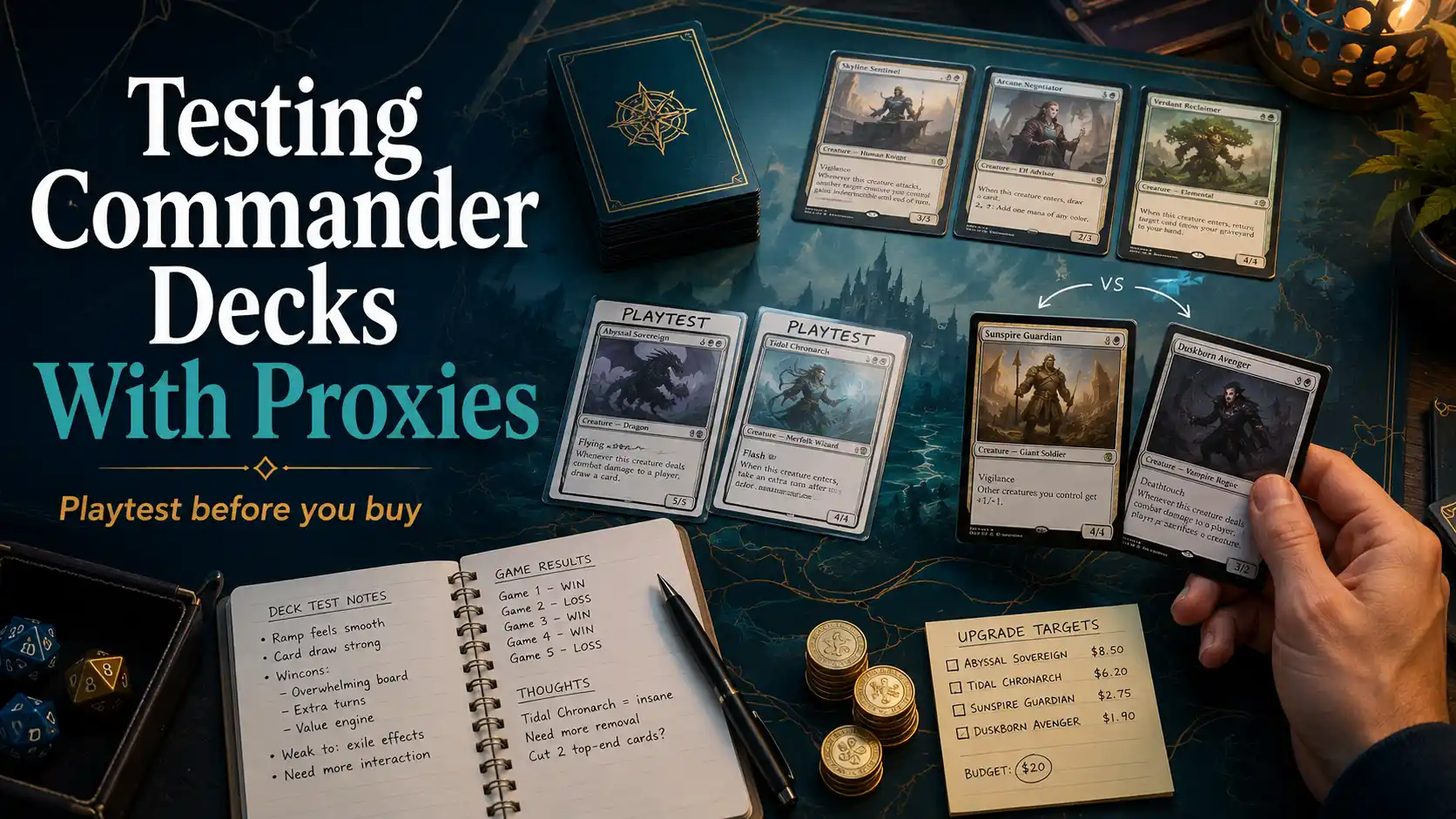
    And if you are still testing before committing real money to a full mana base, our All About MTG Proxy Cards | What They Are and Where to Get Them guide covers the basics. Buying ten premium lands before you know the deck is actually good is certainly a lifestyle choice. I just would not call it a required one.

    The Easiest Way to Remember the List of Shock Lands

    The easiest trick is to remember that the list of shock lands covers every two-color guild pair from Ravnica. One guild, one land. Once you know the guilds, the list stops feeling like trivia and starts feeling organized.

    Another shortcut is to remember a few anchor cards. Blue-white is Hallowed Fountain. Black-red is Blood Crypt. Red-green is Stomping Ground. Green-blue is Breeding Pool. Once those are locked in, the rest usually fall into place.

    Or they do not, and you check the list again like the rest of us. MTG has never been shy about expecting players to memorize a warehouse of nouns.

    Final Thoughts

    The full list of shock lands is not complicated, but it matters. These ten lands are some of the best mana-fixing tools Wizards has ever printed because they give you a real choice: save life, or save time. Most strong Magic cards are really just good decision points wearing cardboard costumes, and shock lands are a clean example of that.

    So if you only wanted the short answer, here it is again: Hallowed Fountain, Watery Grave, Blood Crypt, Stomping Ground, Temple Garden, Godless Shrine, Steam Vents, Overgrown Tomb, Sacred Foundry, and Breeding Pool.

    That is the list of shock lands. Short list. Large consequences. MTG in a nutshell.

    SEO Pack

  • Is Android: Netrunner Still Supported? Where To Play Online and Find Resources

    Last updated: March 21, 2026

    A lot of card games disappear the moment the publisher steps away. Android:Netrunner did not. If you’re searching for Android Netrunner online, the answer is still yes: people are playing, testing decks, teaching new players, and showing up for organized events. But the structure around the game changed, and that is where people get confused.

    The old official Fantasy Flight era is over. The modern game lives through Null Signal Games and a set of community tools that are honestly better organized than a lot of officially supported games. That means the question is not really “does this game exist?” It does. The real question is where you should go first, and what counts as official support now.

    And that is where androidnetrunner.com can matter.

    The Short Answer on Support

    If by “supported” you mean Fantasy Flight Games still publishes Android:Netrunner, no. That ended years ago.

    If by “supported” you mean there are current rules, active formats, new cards, tournaments, deckbuilding tools, and places to play online, then yes, the game is still very much alive. Null Signal Games is handling the ongoing side of Netrunner now, including beginner products, supported formats, organized play, and balance updates. In other words, the original publisher left, but the game itself kept moving.

    That distinction matters. The original Android branding is not the active publishing line anymore. But the actual play ecosystem is still here, still maintained, and still easy to join once you know where the working doors are.

    Why androidnetrunner.com Still Matters

    In my opinion, androidnetrunner.com works best when it acts like a smart front door.

    A returning player usually does not need a long history lesson first. They need clean answers to a few practical questions. Where do I play? Where do I build a deck? Where are the current rules? Where do I find opponents or events? A site that sends people to the right places quickly is doing real work.

    That seems to be the lane androidnetrunner.com is already in. The site shows up as a hub that points readers toward the official current site, event tools, deckbuilding resources, and rules references. That is useful because Netrunner’s modern ecosystem is spread across a few separate sites, each with a different job. You do not want one bloated page trying to do all of them badly.

    If I land on androidnetrunner.com after being away for five years, I want the site to help me orient fast. And if it does that, it is doing its job.

    Where To Play Android Netrunner Online

    Jinteki.net Is Still the Main Place to Play

    For most people, Jinteki.net is the answer.

    It is browser-based, free to use, and built specifically to facilitate online Netrunner matches. If your goal is to sit down and actually play against another person, this is still the first tab I would open. When people talk about Android Netrunner online in a practical sense, Jinteki.net is usually what they mean.

    The one thing worth knowing up front is that Jinteki.net does not pretend to be perfect automation. It explicitly notes that not every rule is fully implemented. For experienced players, that is not a big deal. For new players, it can be a little intimidating at first. You still need to understand timing windows and basic sequencing. But once you get comfortable, it is the center of online play.

    Chiriboga Is the Best Low-Stress Way to Learn

    Chiriboga is one of the best things that happened to new Netrunner players.

    Instead of throwing you into a live game right away, it gives you tutorial decks, advanced decks, learn-to-play flows, and AI-driven practice. That makes it ideal if you want reps without the pressure of another person waiting on every click. You can test lines, mess up, restart, and slowly get your head around how Runner and Corp tempo actually feel.

    I like Chiriboga because it removes the awkward part of learning a complicated game in public. You can make your bad decisions in private, like a responsible adult.

    OCTGN Still Exists, but It Is Not My First Recommendation

    OCTGN is still around, and Android:Netrunner plugins for it still exist. So yes, you can use it.

    But unless you already like OCTGN, I would not point a new or returning player there first. Jinteki.net is easier to access, easier to explain, and much closer to where the active online player base already is. OCTGN is still an option. It just is not the first one I would hand to somebody trying to get back into the game today.

    The Best Official and Fan-Made Resources

    Null Signal Games for Rules, Products, and Formats

    If you want the closest thing to a source of truth in 2026, go to Null Signal Games.

    That is where you find the learn-to-play guide, supported formats, current balance documents, comprehensive rules, and starter products. It is also the clearest proof that Netrunner is still supported in a real sense. A game with live formats, active balance updates, and beginner onboarding is not dead. It is being maintained.

    For brand-new players, System Gateway is still the obvious starting point. Null Signal treats it as the entry product, and that makes sense. It gives new players a clean place to learn without being buried under the full historical card pool on day one.

    NetrunnerDB for Deckbuilding and Card Search

    NetrunnerDB is the deck site. It is where you browse cards, check sets, build lists, view popular decks, and see format and ban list information.

    And this is the site that makes the game feel alive again for returning players. You load a current list, see people still arguing over influence, tech slots, and matchup spread, and suddenly the whole thing stops feeling like an old discontinued curiosity. It feels like a real game community again, because it is.

    Always Be Running for Events

    Always Be Running is where you go when you want actual games on the calendar.

    It tracks recurring meetups, tournament results, online events, and larger organized play activity. If your main problem is “I know the game exists, but where do I find people?” this is one of the best answers. Online events still get posted there, and it remains one of the easiest ways to see that the community is not just alive, but scheduled.

    ANCUR for Older Rulings and Legacy Questions

    If you are playing Eternal, older FFG-era cards, or just hit a bizarre interaction that sends you into rules fog, ANCUR is still useful.

    That kind of resource matters more in Netrunner than people expect. This game has plenty of interactions that feel obvious until they absolutely are not. ANCUR helps fill that legacy-rulings gap, especially for players digging back into older pools instead of only playing the newest formats.

    Discord Still Helps More Than People Admit

    The Green Level Clearance Discord is still a strong place to ask questions, find people, and get pointed in the right direction. Sometimes the fastest path into a game is not another guide. It is one helpful person saying, “here’s the current format, here’s the right deck site, and yes, your old instincts about remote pressure still matter.”

    The Best Starting Path in 2026

    If I were sending a brand-new player into Android Netrunner online today, I would keep it simple.

    Start at androidnetrunner.com so you can see the major community destinations in one place. Then use Null Signal’s learn-to-play material if you need the rules from scratch. Use Chiriboga for your first practice games. Move to Jinteki.net when you want live matches. Keep NetrunnerDB open for decks and card lookups. Check Always Be Running when you are ready to find events.

    If you are a returning player, the path is even simpler. Check the supported formats, grab a current deck from NetrunnerDB, and jam a few games on Jinteki.net. That will tell you more in an hour than three nostalgia threads and a rules argument ever will.

    Final Thoughts

    So, is Android:Netrunner still supported?

    The original Fantasy Flight product line is not. That chapter ended a long time ago.

    But the game itself is still being played, updated, organized, and taught. Null Signal handles the living rules and formats. Jinteki.net handles most live online play. Chiriboga helps new players learn. NetrunnerDB handles decks. Always Be Running handles events. ANCUR helps with older rules questions. And androidnetrunner.com can be genuinely useful because it gives all of that a clean starting point.

    That is the framing I think works best for this site. Not “remember this dead game.” More like: here’s where the live game went, and here’s how to get back in.

  • Why board wipes matter more in Commander

    A normal one-for-one removal spell answers one permanent. That can be great. It can also be wildly insufficient when one player has made ten tokens, another has suited up a Voltron threat, and the third has an engine creature that should have been killed two turns ago.

    That is the part newer players often miss. Commander is multiplayer. Problems stack up faster. A board wipe scales better than spot removal because it can catch you up against more than one player at once. It is not elegant. It is just useful.

    Kraken Opus already has a broader shell for this in MTG Deckbuilding Checklist. I think that article gets the big picture right. The trick now is zooming in. It is one thing to say “play some wipes.” It is another to know whether your deck wants two, three, or five.

    Commander board wipes: start with three

    For most normal Commander decks, I think three board wipes is the best starting point.

    Not because three is magical. And not because every deck should land on exactly three forever. It is just the cleanest baseline. Three gives you enough access to a reset button without clogging your hand with expensive cards that do nothing while you are ahead.

    If you want the fast version:

    • 2 wipes for creature-heavy or commander-centric decks that commit a lot to the board
    • 3 wipes for most midrange Commander decks
    • 4 to 5 wipes for control decks, spell-heavy shells, or metas where boards snowball constantly

    That lines up pretty well with how a lot of real decks behave. Creature decks hate sweeping their own stuff, so they tend to go lower unless they can break parity. Control decks are more interested in preserving life total, buying time, and resetting the table, so they tend to go higher.

    And if your deck is struggling to cast its higher-end interaction on time, fix the mana first. A clunky wipe package can feel worse than no wipe package if the deck is stumbling early. That is one reason MTG Commander Ramp: How Much Ramp Is Right for Your Deck? matters so much alongside this topic.

    When two wipes is enough

    Two is fine when your deck is built to be the board.

    If you are playing a go-wide creature deck, a tribal deck, an aggressive counters deck, or a commander that wins by snowballing bodies, loading up on traditional wraths can make your own draws feel miserable. You do not want to spend the early turns building pressure just to stare at a hand full of cards that tell you to erase your own progress.

    That does not mean you skip wipes entirely. It means you become choosy.

    In these decks, the best wipes are usually the ones that leave you with something:

    • asymmetrical wipes
    • wipes that spare your card type or tribe
    • modal wipes that can be something else when the board is stable
    • wipes attached to a finisher or a huge tempo swing

    That last category matters more than people admit. A good wipe in a proactive deck is often the one that clears blockers or resets everyone else while your plan survives. That is not a defensive card anymore. That is a closer.

    When four or five wipes is right

    If your deck is creature-light, reactive, or trying to win later with inevitability, you can absolutely justify four or even five wipes.

    This is especially true if your playgroup loves token boards, protection spells, and giant “value” turns that dump half a battlefield into play. Some tables just produce too much cardboard too quickly. When that happens, being the player with only one wrath starts to feel optimistic in a bad way.

    A few signs your deck wants more than three:

    You are often behind on board by turn six.

    Your commander does not mind long games.

    Your deck wins with engines, combo lines, or incremental inevitability instead of creature pressure.

    Your pod tends to rebuild quickly, so one reset is rarely enough.

    If that sounds like your table, four wipes is not excessive. It is realistic.

    Pick wipes that actually fit your plan

    This is where a lot of deckbuilders go wrong. They count board wipes correctly and then choose the wrong ones.

    A wipe is not just a wipe. Some destroy. Some exile. Some give indestructible decks a shrug and a smile. Some kill small creatures but not big ones. Some are cheap but narrow. Some are expensive but break parity hard enough to win the game on the spot.

    The best commander board wipes are the ones that make sense for your deck, not the ones that look generically “strong” in a vacuum.

    If your deck is full of artifacts, maybe you want creature wipes that spare artifacts.

    If your deck wins through the graveyard, maybe exile-based sweepers hurt you more than they help.

    If your commander naturally survives certain wraths, that matters.

    If your deck can rebuild fast, a cheaper symmetrical wipe is easier to live with.

    And if your meta keeps hiding behind hexproof, ward, or giant sticky boards, you may want more true reset buttons and fewer cute answers.

    A simple question helps here: after I cast this wipe, who is happiest? If the answer is “probably not me,” it may be the wrong wipe for your deck even if the card is objectively good.

    Common mistakes with commander board wipes

    The biggest mistake is playing zero and calling it confidence.

    Sometimes zero is defensible. Most of the time it is just a deckbuilder telling themselves their threats are somehow more honest than everyone else’s.

    The second mistake is overloading on expensive wraths. A pile of five and six mana wipes looks fine on paper until your early game falls apart and you die before they matter. If your wipes are all late, your “safety net” is actually a decorative rug.

    The third mistake is treating wipes as purely defensive. In real games, a good wipe is often a setup spell. You clear the table, untap first, land your engine, and suddenly the wipe was not a bailout. It was your pivot turn.

    The last mistake is holding them too long. Commander players love to get greedy with wipes. “Maybe someone else answers it.” “Maybe it gets worse and I get more value.” “Maybe I can wait one more turn.” Then one more turn becomes dead.

    Sometimes the right time to wipe is before the table gets impossible, not after.

    The clean recommendation

    So, how many board wipes should you play in Commander?

    Start at three.

    Go down to two if your deck is very creature-heavy or built to dominate the battlefield itself.

    Go up to four or five if your deck is reactive, creature-light, or your meta keeps turning into a crowded mess by midgame.

    Then pick wipes that fit your plan instead of just copying the most famous ones. That part matters more than people think.

    Commander board wipes are not glamorous. But neither is losing because three opponents built a board and you brought one Go for the Throat plus good intentions. In my opinion, most decks should respect that reality a little more.

  • Hello world!

    Welcome to WordPress. This is your first post. Edit or delete it, then start writing!