
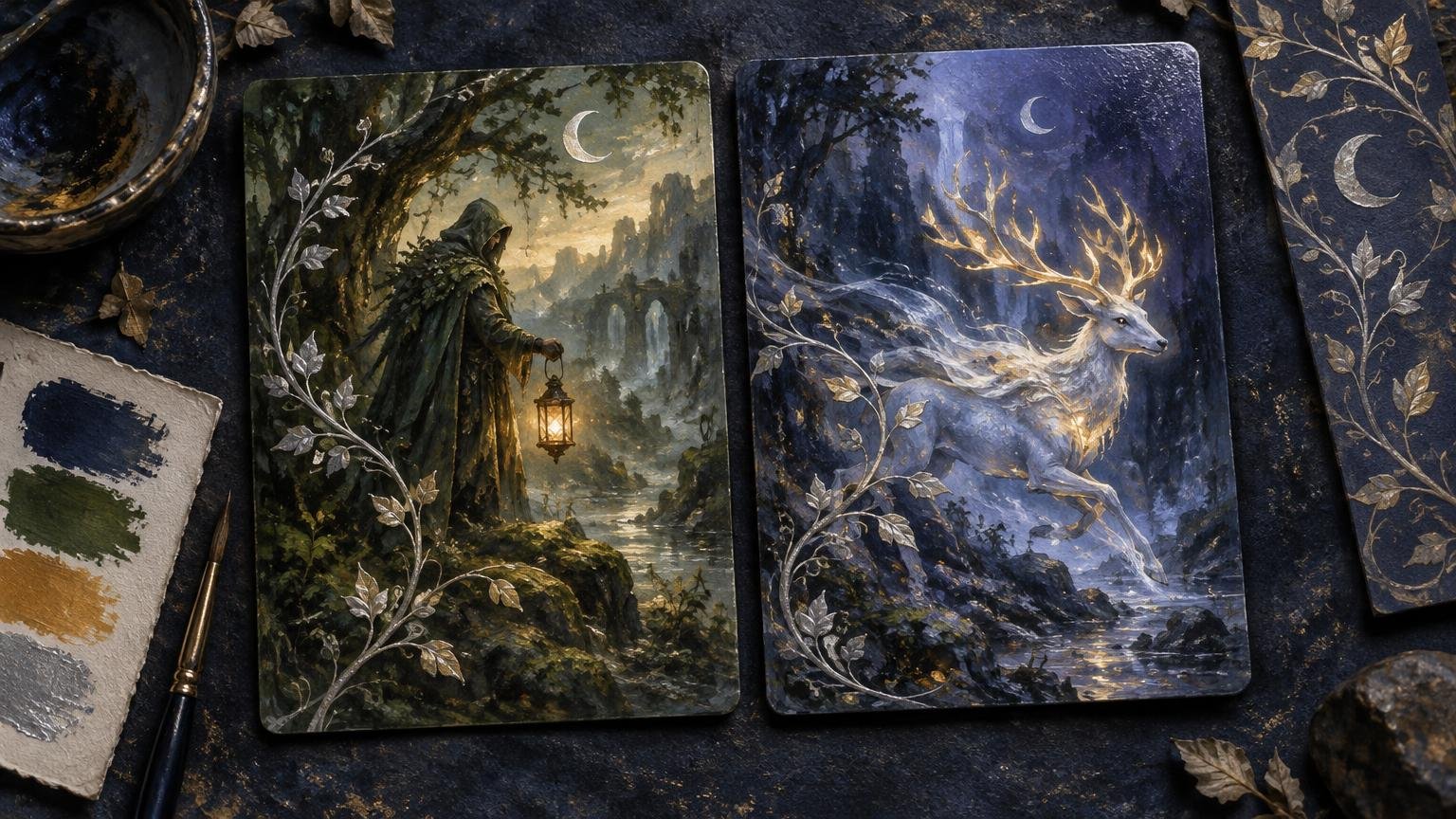
Alternate-art DFC proxies work best when their two faces feel like different moments in the same story—not two attractive designs that happened to share a sleeve. Establish a visual constant, define what changes between faces, and preserve the same information hierarchy on both. Then proof the pair at final card size, because subtle connections and delicate type treatments often disappear once the artwork leaves a large monitor.
TLDR
- Choose two or three elements that remain constant across both faces: a motif, frame structure, type system or accent color.
- Use palette, composition and lighting to show what changes from one face to the other.
- Keep card name, type line, rules text and combat information in dependable locations.
- Design transforming DFCs as a visual progression; design modal DFCs as related alternatives.
- Proof both faces together at actual size and record each face as a separate, clearly named file.
Start by identifying what kind of DFC you are designing
Not every double-faced card tells the same kind of story. Transforming double-faced cards move between faces, while modal double-faced cards let the player choose which face to cast or play rather than ordinarily transforming between them. Wizards’ Kaldheim mechanics guide explains that distinction. Your art direction should reflect it.
For a transforming card, design movement: calm to violent, dormant to awakened, human to monster, intact to ruined. The second face should feel like a consequence of the first. For a modal DFC, design parallel possibilities instead. Both faces can share a world and visual language without implying that one chronologically becomes the other.
This fits the broader history of the layout. Wizards has described double-faced cards as beginning as a way to express transformation before expanding into other forms of duality and choice. The practical lesson is simple: decide whether your relationship is progression, contrast or choice before selecting artwork.
Build the connection from three shared elements
Trying to repeat everything makes the second face feel like a recolor. Repeating nothing makes the pair feel accidental. Pick three anchors and allow the rest to change.
1. A recurring visual motif
Carry one recognizable shape or object across the divide: a moon, doorway, crown, branch pattern, weapon silhouette or ring of runes. Change its condition or meaning on the second face. A pristine crown can become cracked; a distant doorway can open; a white flower can return as ash. This creates continuity without requiring identical compositions.
2. A controlled palette relationship
The faces do not need matching colors, but their palettes should have a rule. Keep one accent color constant while shifting the dominant values, or move from warm to cool while retaining the same neutral shadows. If the entire deck already follows a palette system, use the DFC pair as a variation within that system rather than an exception to it. The full-deck color palette guide provides a useful framework for assigning dominant, supporting and accent colors.
3. Stable typography and information zones
Keep the name, type line, rules box and power/toughness treatment in familiar places. Decorative changes can signal transformation, but players should not have to relearn the card on its second face. Stable information placement reduces the recognition burden across a large project, especially when several cards use specialty layouts. If the frame treatment starts competing with the rules text, return to the principles in the alternate-frame readability guide.
Use composition to create face-to-face storytelling
Composition can connect the faces before the viewer notices any repeated symbol. Mirror the subject’s position, preserve the horizon line or carry a diagonal movement through both illustrations. A figure looking toward the right edge on the first face might reappear facing the viewer on the second. A tower centered on face A might leave a centered column of smoke on face B.
The strongest pairs usually combine one constant with one decisive change. Keep the camera angle but alter the environment. Preserve the silhouette but change the pose. Repeat the background architecture while changing the light source. This gives the eye enough evidence to recognize the relationship while letting the transformation or modal choice remain dramatic.
Avoid relying on tiny continuity details. A repeated pendant may look clever at full-screen size and vanish completely on a physical card. Make the primary connection visible in the large shapes, value structure or dominant color; let small symbols reward closer inspection rather than carry the entire concept.
Design for handling, not just for a two-image mockup
A physical double-faced card has two faces instead of the normal Magic back. Official guidance says that a DFC in an opaque sleeve is removed from the sleeve when it transforms. Wizards’ double-faced card rules guidance also describes the official substitute-card mechanism used when opaque sleeves are unavailable. That handling reality should influence the design.
Both faces need to survive independently. Do not place a critical visual clue only on the opposite face, and do not assume players will remember which side contains a particular ability. Give each face a complete, readable identity while using art direction—not missing information—to connect the pair.
For projects with multiple DFCs, make orientation obvious. Use consistent face indicators, filename suffixes and export order. Never rely on “front” and “back” alone if your project mixes transforming and modal layouts; those labels become ambiguous surprisingly quickly.
Use a file system that treats each pair as one asset
Store the two exported faces separately but track them as a linked unit. A practical naming pattern is cardname-A-v03 and cardname-B-v03, with additional fields in the production sheet for DFC type, frame version, crop version and approval status. Large custom projects benefit from tracking face configuration explicitly rather than trusting memory at handoff.
- Confirm that both files use the same final dimensions and export settings.
- Check that the paired files carry the same revision number.
- Record whether the card is transforming or modal.
- Review names, mana costs, type lines, rules text and combat values independently.
- Include a small proof image showing the two faces side by side.
- Archive replaced versions rather than overwriting the only previous file.
The broader custom proxy project checklist can help organize approvals and handoff across the rest of the deck. If the finished files are ready for a physical playtest-card workflow, printmtg.com is a possible next step; confirm its current DFC and file-handling options before submitting the project.
Proof the relationship at actual card size
Review each face alone, the two faces side by side and the card among the rest of the deck. These are three different tests. The isolated view catches text and crop problems. The paired view tests storytelling. The tabletop grouping reveals whether the card still belongs to the larger visual system.
At final size, check whether the repeated motif remains visible, whether dark artwork collapses behind the text box and whether the second face looks more visually important than intended. Also compare the card under ordinary room lighting rather than judging only from a bright screen. The governing rule is straightforward: a DFC pair should share a visual grammar, but each face must remain legible enough to function without an explanation.
FAQ
Should both faces use the same frame?
Not necessarily. Keep the underlying information grid consistent, then vary borders, ornament or texture to support the change. A transformed face can feel more unstable without moving every functional element.
How different can the two palettes be?
They can be strongly contrasting if one bridge remains obvious. A shared accent color, repeated neutral or consistent lighting effect is often enough to connect warm and cool faces.
Should modal DFC faces mirror each other?
Mirroring can work, but avoid implying transformation when the card represents a choice. Parallel framing, related motifs and equal visual weight usually communicate alternatives more clearly.
Can player-made DFC proxies be used in sanctioned events?
The February 27, 2026 Magic Tournament Rules say cards used in sanctioned events must be genuine, regulation-sized Magic cards publicly released by Wizards. Player-made proxies are not permitted; judge-issued proxies are limited to specified tournament circumstances. Consult the current Magic Tournament Rules before an event.