TLDR: Build a custom Commander proxy gift deck around the recipient, not merely around attractive art. Choose the commander and working decklist first, write one visual rule for the project, and apply it consistently to the cards, lands, tokens, helper pieces, and back. Test a small group of difficult cards before finishing all the files, then proof the completed deck at card scale and across a simulated battlefield.
The best custom Commander proxy gift deck feels as though it could only belong to one person. It might reference a favorite book, a beloved pet, a shared campaign, a wedding, an old playgroup joke, or simply the recipient’s preferred art style. Personal does not have to mean covering every card with photographs. A restrained motif, carefully chosen commander, and short dedication can carry more emotional weight than 100 unrelated references.
The practical answer is to make decisions in this order: recipient, commander, decklist, visual brief, card hierarchy, supporting pieces, test set, full production, and presentation. That sequence prevents the common failure mode in which dozens of beautiful files are completed before anyone notices that the theme fights the commander’s color identity, an essential token is missing, or text-heavy cards are unreadable.
Start with the person, occasion, and intended use
Before choosing artwork, write down what the gift is meant to communicate. A birthday deck can be playful; a wedding or memorial project may call for a quieter visual approach. Decide whether the recipient enjoys sincere references, loud jokes, understated design, or recognizable characters. Also determine whether the deck is mainly for play, display, or both. A display-oriented card can reward close inspection, while a playable deck needs names, costs, types, and battlefield roles to remain legible at a glance.
- Occasion and the date by which the project must be ready
- Recipient’s favorite commander, colors, mechanics, fictional settings, art styles, pets, places, or shared memories
- Tone: celebratory, dramatic, nostalgic, humorous, elegant, or intentionally strange
- Primary use: regular casual play, occasional display, or a mix of both
- Elements to avoid, including unwanted jokes, sensitive photographs, disliked characters, or visually confusing treatments
- Whether the recipient’s usual playgroup is comfortable with clearly identified unofficial cards
For a surprise, ask mutual friends for preferences without revealing the whole project. If uncertainty remains, adapt an existing favorite deck rather than introducing an unfamiliar commander. The recipient already understands how that deck plays, and the gift becomes a new visual edition of something they value. A new commander can be the better choice when the deck itself is part of the surprise, but it introduces more gameplay and preference risk.
Choose the commander before defining the art system
The commander is both the gameplay anchor and the visual lead. Confirm the decklist before commissioning or preparing a full set of images. Wizards describes Commander as a 100-card format, including the commander, with singleton construction apart from basic lands and deckbuilding constrained by the commander’s color identity. Its official Commander format overview is the appropriate reference when checking those structural requirements.
A finished list also reveals what the visual system must handle. A creature-heavy deck may need many tokens and clear creature silhouettes. A planeswalker-focused project may require coordinated emblems. A transform-heavy deck creates front-and-back decisions. A deck with many tutors or similar combo pieces benefits from stronger visual differentiation than a collection made primarily for display.
Once the list is stable, give the commander a controlled exception rather than an entirely different design language. It might receive a brighter accent, expanded border treatment, unique symbol, or more cinematic crop. The commander should look important without appearing to come from another project.
Write a one-sentence brief for the custom Commander proxy gift deck
A brief turns a loose theme into a repeatable rule. Use this fill-in structure: “A [mood] deck set in [setting], using [palette], with [recurring motif], while the commander receives [hero treatment]; avoid [excluded styles or references].”
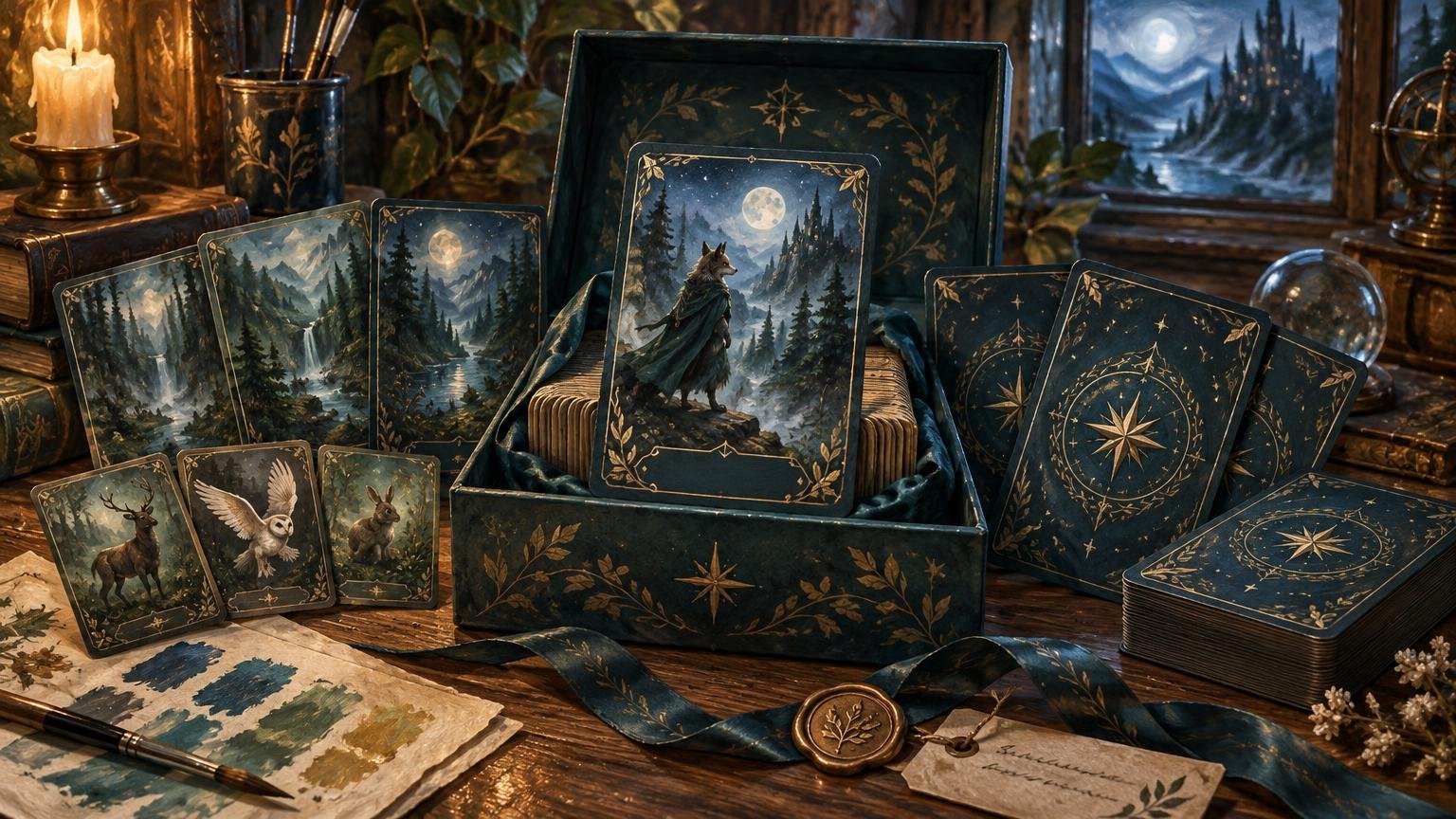
For example: “A warm storybook deck set around an overgrown observatory, using deep blue, moss green, parchment, and small gold stars, with circular window motifs; the commander receives the only full gold frame, and no card uses photorealistic space imagery.” That sentence is specific enough to guide crops, lands, tokens, and backs without demanding that every illustration look identical.
Assign jobs to the palette rather than choosing a bag of favorite colors. One color can dominate backgrounds, another can identify interactive cards, and a bright accent can be reserved for the commander and signature spells. The deck-wide color palette guide explains how controlled roles and exceptions keep an alternate-art deck cohesive without flattening every card into the same composition.
Build a hierarchy instead of decorating every card equally
A gift deck needs visual rhythm. If every card receives maximal detail, borderless art, glowing accents, and a unique frame, nothing feels special. Group cards by importance and give each group an appropriate level of emphasis.
| Project group | Recommended visual role | What to protect |
|---|---|---|
| Commander | Primary hero treatment and clearest expression of the theme | Immediate identity, name, mana cost, and defining abilities |
| Signature cards | Secondary accents or recurring character and location motifs | Fast recognition during important turns |
| Supporting deck | Consistent frame, palette, and crop rules | Card-to-card readability and useful variation |
| Basic lands | Coordinated cycle with distinct land identities | Color-source recognition across the table |
| Tokens and helpers | Simplified extension of the main visual language | Type, size, abilities, counters, and tapped state |
Reserve the most personal material for cards that matter. A pet might represent the commander’s companion token. A meaningful location might appear across the basic-land cycle. Friends could appear as a small group of legendary creatures rather than being scattered over incidental spells. This gives the references context and avoids turning the deck into a collage.
Design lands, tokens, and special pieces as complete systems
Basic lands occupy enough visual space to influence the entire deck. Give them a shared composition, border language, or recurring object, but preserve unmistakable differences among the land types the deck uses. Color alone is a weak identifier in dim rooms or for players with color-vision differences; combine palette with landscape, symbol, framing, or typography cues. The guide to building a matching custom basic-land cycle provides a useful planning method for repeatable treatments and cycle proofing.
Next, inventory everything the deck creates or references: creature tokens, artifact and enchantment tokens, emblems, counters, dungeons, initiative or monarch reminders, copy markers, and any other helper pieces. These extras sit outside the 100-card deck, but they are part of the gift experience. A missing signature token is particularly noticeable when every main-deck card has been customized.
Use a simplified frame for tokens so their information can be read quickly. Put the token name, creature types, power and toughness, relevant abilities, and meaningful status cues ahead of decorative text. If the deck creates several visually similar tokens, vary their silhouette or frame marker rather than relying on tiny labels.
Track double-faced and other unusual cards separately. Decide whether each will be represented by a double-faced piece, a helper card, or another transparent arrangement suitable for the recipient’s casual environment. Whatever method you choose, test it with the planned sleeves and make sure the main deck does not contain unintentionally distinguishable backs.
Treat the custom back as the deck’s signature
A custom back can carry the deck title, a compact logo, a date, a small dedication, or a symbol shared across the project. Keep it restrained. A complicated montage that looks impressive on a monitor can turn into visual noise at card size.
Use one consistent back for the main deck, leave clear space around the logo, and include an obvious unofficial identifier. If double-faced cards require a different treatment, document that choice and plan around opaque sleeves. The custom proxy back and deck-logo guide covers scale, contrast, clear space, and consistency across a complete project.
Create a small test set before completing 100 cards
Do not use the easiest six illustrations as the proof of concept. Select cards that expose the system’s weaknesses. The test set should include the commander, a text-heavy card, both dark and bright artwork, one basic land, one token, and at least one unusual layout used by the deck.
- Reduce each test file to final card size and check whether faces, symbols, and focal objects still read clearly.
- View the tests together rather than individually; inconsistent borders and shifting text positions become obvious as a group.
- Place the cards in a simulated battlefield with sleeves or card-sized mockups and check recognition from normal playing distance.
- Check names, mana costs, type lines, rules text, power and toughness, loyalty information, and token labels against the frozen list.
- Review the brightest and darkest files for lost details, weak text contrast, and muddy crops.
- Ask whether the commander is visually distinct without making the rest of the deck feel unfinished.
This is also the point to confirm the finish and production path. Reflective or glossy treatments may interact poorly with dark scenes, delicate gradients, and low-contrast text, so avoid making finish-dependent promises without a provider-specific proof. If you decide to order physical cards, compare your exports with the current requirements of the chosen service, whether that is Proxy King for MTG proxies or another provider.
Track artwork, revisions, and approvals
Large projects become fragile when files are named “final,” “final2,” and “final-really.” Assign every deck slot a stable project ID and keep the printed card name in the filename. Maintain one tracker containing the quantity, art source or rights note, crop version, front version, back version, special handling, approval state, and final-export status.
Distinguish personal photographs, original artwork, commissioned work, and licensed material from third-party images. Record the relevant permission or commission terms where applicable rather than assuming that finding an image makes it available for the project. This is project documentation, not a substitute for legal advice, but it prevents confusion when a card must be replaced months later.
Freeze the list before final export and move superseded files into an archive instead of deleting or overwriting them. The custom proxy project checklist provides a broader workflow for stable IDs, special-card tracking, version control, and final handoff.
Package the deck like a finished gift
Presentation should explain the project without overwhelming the recipient. Give the deck a title, then include a short dedication or insert describing the central idea. A small inventory can identify the commander, tokens, helper pieces, and any replacement files. If the deck contains personal photographs or references that are not immediately obvious, explain only the ones whose meaning adds to the gift; leave room for discovery.
Keep the playable cards clearly unofficial and discuss their use with the recipient’s playgroup. Wizards’ published proxy-policy statement says sanctioned events require authentic Magic cards apart from the narrow judge-issued replacement circumstances described in that policy. The official policy statement on proxies provides the relevant event context. A personalized gift deck should not be presented as an authentic product or as a general substitute for sanctioned-event cards.
Frequently asked questions
What makes a Commander proxy gift feel genuinely personal?
Specificity and restraint. Build around one or two meaningful references, then repeat them through palette, symbols, locations, tokens, and presentation. A coherent observatory motif tied to a shared memory will usually feel more personal than placing unrelated favorite characters on every card.
Should I customize an existing deck or create a new one?
Customize an existing favorite when you want the safer gift: the recipient already likes its commander and gameplay. Build a new deck when discovery is part of the present and you understand the recipient’s preferred colors, mechanics, power expectations, and playgroup well enough to choose confidently.
Does every card need unique artwork?
No. Reusing controlled backgrounds, frame treatments, motifs, or land compositions can strengthen cohesion and reduce project complexity. Prioritize unique art for the commander, signature cards, and personally meaningful references. Supporting cards can rely more heavily on the shared system.
What should I check immediately before final production?
Confirm the frozen 100-card list, every extra token and helper piece, filenames, quantities, front-and-back pairings, permissions notes, card text, crops, and export status. Then inspect the full set at card size and in groups. The final question is not whether each image looks attractive alone; it is whether the entire gift reads as one playable visual system.
Finish with one clear design rule
Before preparing the complete custom Commander proxy gift deck, write its visual rule in one sentence and build the difficult test cards. If the commander, darkest card, busiest rules box, basic land, and token all feel related and remain readable, the system is ready to scale. If they do not, revise the rule now—before the same problem appears across the entire deck.