
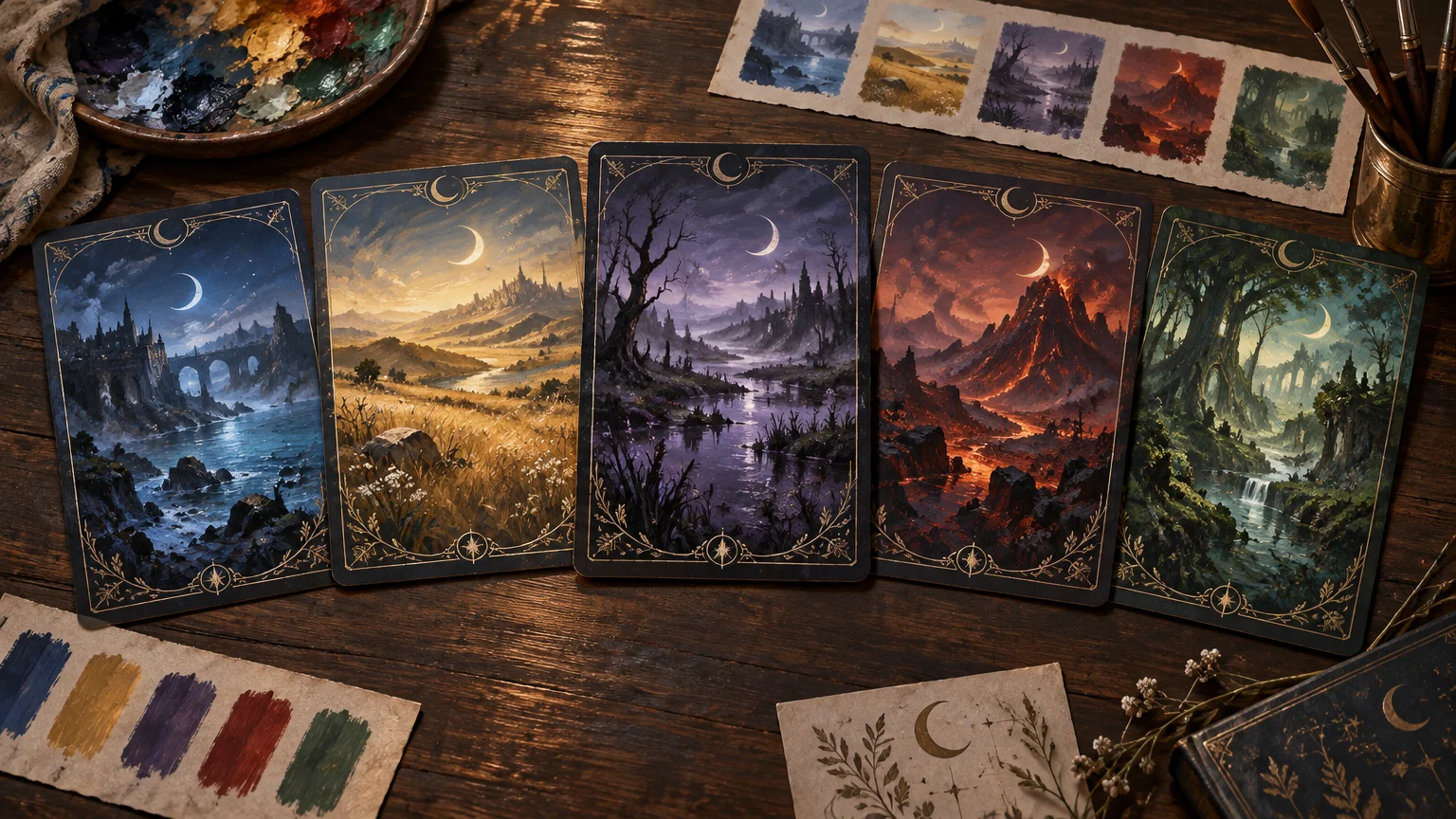
TLDR: Build one strong, repeatable treatment for each basic land type your deck uses. Connect the lands through a shared setting, illustration style, frame, lighting rule, and recurring motif, but give every type a distinct scene role and color cue. Review the treatments together on one proof sheet before duplicating them across the deck.
A custom proxy basic land cycle does not need 20, 30, or 40 unique illustrations. For most Commander projects, the better system is one coordinated design per basic land type in the deck, repeated for every copy. A three-color deck may therefore need only three finished treatments. The creative work goes into making those treatments feel related without making them interchangeable.
Think of the cycle as a miniature version of the deck’s overall art direction. It should establish where the deck exists, what its visual mood is, and which design rules hold everything together. At the same time, a player should still be able to separate a Forest from a Swamp immediately when scanning a crowded battlefield.
What is a custom proxy basic land cycle?
A cycle is a group of related designs that follow the same concept while giving each member a distinct role. For custom basic lands, that usually means one treatment for each land type the deck actually uses: Plains, Island, Swamp, Mountain, and Forest. Magic associates each of those five basic land types with an intrinsic mana ability, so accurate names and conspicuous mana identity are functional anchors rather than decorative details. Wizards’ Magic keyword glossary provides the official basic-land summary.
You do not have to design all five. A mono-color deck may need only one land treatment, while a two- or three-color deck needs only the relevant subset. Designing unused land types can be worthwhile if the project will later expand into a Cube or a coordinated group of decks, but it should not distract from completing the current deck.
The individual copies also do not need unique art. Repeating a carefully designed Island creates a stronger visual rhythm than filling the deck with unrelated ocean images. If more variety is desirable, create a small variant family only after the primary treatment works: for example, dawn, dusk, and night versions that preserve the same composition and frame.
Start with one setting, not five separate pictures
The easiest way to lose cohesion is to search for each land independently. A snowy Plains, tropical Island, gothic Swamp, volcanic Mountain, and storybook Forest might all be attractive, but together they describe five different decks. Start by writing one sentence that defines the world shared by the cycle.
A useful art-direction sentence names the setting, mood, and repeated visual device. For example: “Every land depicts part of an abandoned astronomical city at twilight, with a broken brass orrery visible somewhere in the scene.” That sentence gives an artist or designer a system rather than a loose theme.
Then assign each land a geographic or architectural role inside that world:
- Plains: a pale observatory terrace open to the horizon.
- Island: a flooded archive reflecting the twilight sky.
- Swamp: a submerged garden beneath decaying domes.
- Mountain: a shattered tower lit by a furnace or red celestial event.
- Forest: an overgrown courtyard where roots have consumed the instruments.
The scenes belong together because the setting, time of day, materials, and recurring orrery motif remain constant. They remain distinguishable because their silhouettes, dominant value patterns, environmental features, and mana-color cues differ.
Choose the constants and variables in the cycle
A coherent custom proxy basic land cycle needs both repetition and controlled variation. Too little repetition makes it look assembled from leftovers. Too little variation turns the mana base into a blur.
| Design element | Keep consistent | Allow to vary |
|---|---|---|
| Illustration style | Rendering method, texture, and level of detail | Terrain, focal structure, and environmental effects |
| Palette | Shared neutrals and overall saturation range | A recognizable accent associated with each land type |
| Lighting | Direction, softness, and time-of-day logic | Local light sources such as fire, moonlight, or bioluminescence |
| Composition | Horizon position or focal-point zone | Silhouette and visual movement within that structure |
| Frame and typography | Frame treatment, title placement, border logic, and type style | Land name and mana symbol |
| Recurring motif | One project symbol, material, plant, creature, or weather device | Its size, condition, and placement in each scene |
The deck’s full palette should guide these decisions. If the rest of the project already has defined dominant, support, and accent colors, bring the lands into that system rather than starting again. The process in building a color palette for a full alternate-art proxy deck can help establish those roles before the land art is finalized.
One accent color should not carry the entire burden of identification. Color can become muted by dark artwork, a finish, ambient lighting, or viewing distance. Pair it with a second cue: open horizontal space for Plains, water or a strong horizontal reflection for Island, low murky shapes for Swamp, angular peaks or rising heat for Mountain, and branching vertical forms for Forest.
The art can be metaphorical, but recognition must survive
A Plains illustration does not have to show literal grassland. In a space-opera deck, it could depict a white-lit orbital platform; in a haunted-library deck, it could be a vast reading hall. What matters is that the scene role, land name, mana cue, and composition work together.
Use a three-part recognition test. First, inspect the card alone: is its identity obvious without explanation? Second, place the full cycle side by side: does each treatment separate cleanly from its neighbors? Third, reduce the designs to something close to their eventual viewing size: do the focal shapes and labels remain useful, or does everything collapse into dark texture?
Detailed art often fails at the third stage. Fine windows, leaves, stars, and filigree may be beautiful in a full-screen file but merge after reduction. Favor one strong focal shape, a controlled background, and enough separation behind the title and type information. If the land can be recognized only by zooming in, revise the composition rather than adding more decorative detail.
Make the frame part of the land system
A matching frame can unify art that contains necessary color variation. Lock the border treatment, title location, typography, text backing, corner details, and symbol placement before producing duplicates. The viewer should understand that every basic land belongs to the same project even when the illustrations cover different environments.
The commander may use an elaborate hero frame, but the lands usually benefit from restraint. They will appear repeatedly and often in groups. A dense ornamental treatment multiplied across six permanents can create more battlefield noise than one dramatic commander card.
Custom backs can carry the strongest deck branding if the lands’ fronts need to remain quiet. A project emblem, shared texture, or deck title on the back can connect the set without competing with the functional information on each face. If the deck includes double-faced cards, decide early whether those cards need separate handling rather than discovering the conflict during final export.
Build a five-card proof sheet before making duplicates
The proof sheet is where the cycle becomes a system. Place one example of every treatment together at the same scale and in the same orientation. Do not judge each land only in its individual editing window.
Review the sheet in passes rather than trying to evaluate everything at once:
- Identity pass: cover any large decorative mana symbols and confirm that the name, scene, and remaining cues still distinguish each land.
- Cohesion pass: check whether the illustrations appear to share a setting, era, medium, and lighting logic.
- Value pass: compare the lightest lights, darkest shadows, and focal contrast. One land should not look accidentally faded or crushed beside the others.
- Frame pass: confirm consistent title positions, border widths, text backing, ornament scale, and alignment.
- Reduction pass: view the sheet near card size and look for lost focal points, muddy shadows, thin details, or cramped labels.
- Repetition pass: duplicate each design several times on a temporary battlefield layout. A treatment that looks elegant once may become visually exhausting in a cluster.
- Exception pass: inspect lands with unusually dark, bright, or detailed art. Decide whether to revise them or document them as intentional exceptions.
Proof the intended front design first, then consider any finish or production choice. Reflective, glossy, or holographic effects can interact differently with dark values, gradients, and fine detail, so avoid assuming that an effect will rescue low-contrast art. Verify the chosen provider’s current file and finish requirements before handoff.
Use version control that can survive a future deck update
Basic lands are easy to revisit months later when a deck changes color balance, gains a new theme variant, or needs a replacement file. Ambiguous names such as “forest-final-new2” make that unnecessarily difficult.
Use predictable filenames that identify the project, land, treatment, and revision. A structure such as “observatory-forest-primary-v03” is readable without opening the file. Keep editable source files separate from approved exports, and record which crop, frame, type treatment, and artwork source were selected.
A simple project manifest should contain:
- The exact basic land types used in the deck.
- The approved filename and revision for each treatment.
- The source or permission status of each piece of art.
- The selected crop and any intentional exceptions.
- The frame and card-back versions shared by the cycle.
- The date of the final proof review.
- Notes needed to recreate a replacement or add a later variant.
Only duplicate files after the primary cycle is approved. Otherwise, a correction to one Island treatment can turn into a hunt through numerous exports. When the designs are ready for a physical handoff, printing MTG proxy cards is a separate production step; keep the approved masters unchanged and create provider-specific exports from them.
Extend the visual rule carefully
Once the land cycle works, its visual language can support related pieces such as Treasure tokens, creature tokens, emblems, Monarch cards, or other table helpers. Reuse one or two signals rather than copying the entire land frame. The brass orrery from the observatory example might become the token border ornament, while the shared twilight gradient appears behind an emblem.
The goal is family resemblance, not uniformity. Tokens need different information hierarchy from lands, and helper cards may need to remain recognizable from across the table. Let the recurring motif identify the project while the layout identifies the object’s function.
Frequently asked questions
How many unique basic-land designs does a Commander deck need?
Usually one per basic land type used. Repeating that treatment is efficient and visually cohesive. Add variants only when they follow the same system and provide enough benefit to justify additional proofing and file management.
Should a five-color deck use all five traditional mana colors prominently?
Not necessarily. A shared neutral palette can dominate the cycle, with mana colors used as controlled accents. Combine those accents with different silhouettes, environments, names, and mana symbols so identification does not depend on hue alone.
Do all lands need artwork from the same artist?
No, but they should share a compatible visual language. Similar rendering, texture, lighting, composition, and detail density can connect work from different sources. Record the source and permission status of every image; finding art online does not by itself establish permission to reproduce it.
Should every copy of a basic land use the same artwork?
That is the strongest starting point. If repetition feels too rigid, use a small set of controlled variants—such as seasonal or time-of-day changes—while preserving the frame, scene structure, mana cues, and recurring motif.
Finish the system before expanding it
The practical rule is simple: one world, one treatment per basic land type used, and one proof sheet that forces the designs to coexist. Establish the shared frame, palette, lighting, and motif first. Then make each land recognizable through its scene role, silhouette, label, and mana cue. Approve those primary designs before creating duplicates, variants, tokens, or production exports. Five disciplined treatments will usually make a deck feel more intentional than dozens of unrelated illustrations.