TLDR
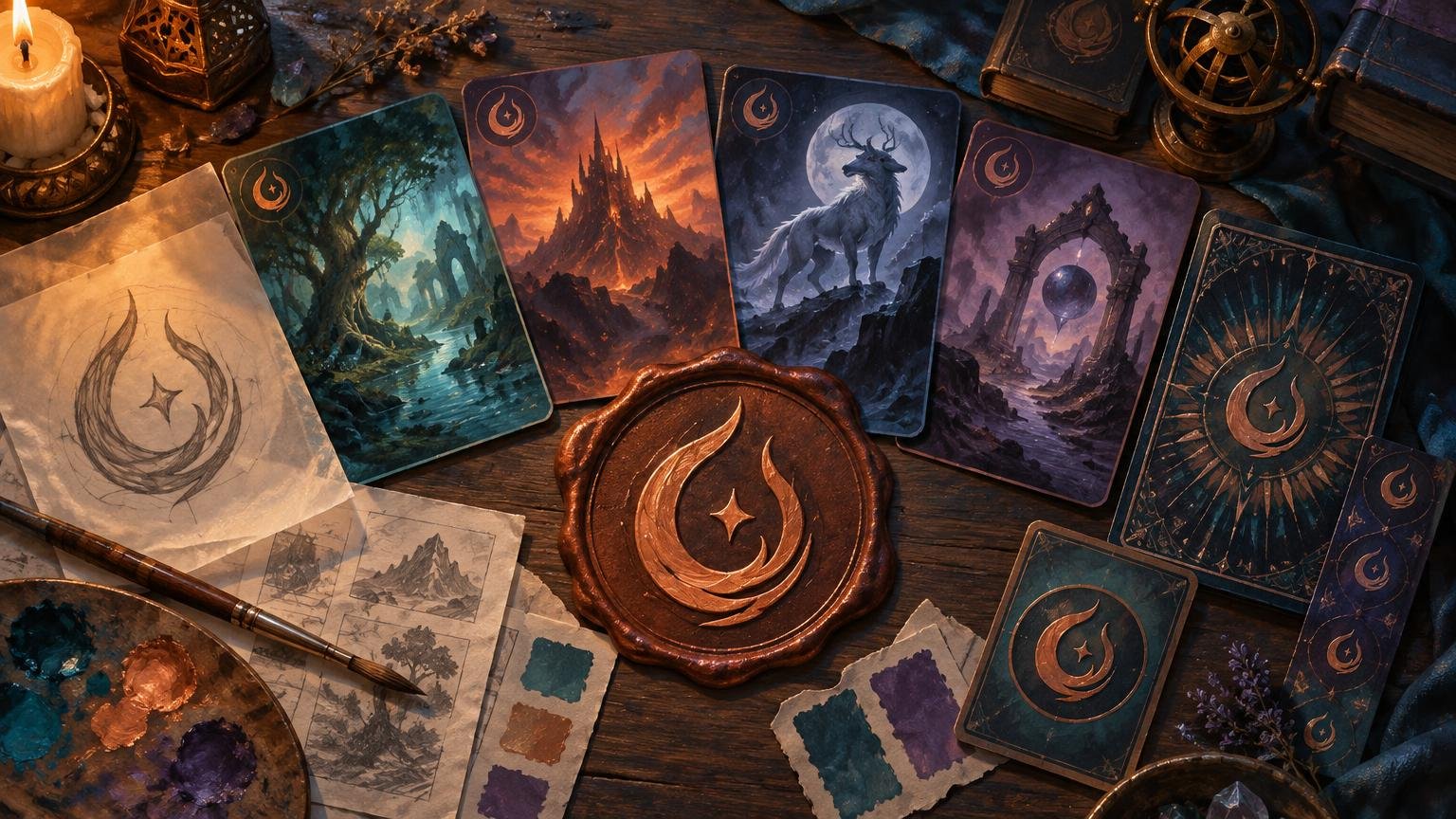
For a coherent custom set symbol proxy deck, create one simple emblem and give it a defined job. Use the same master silhouette across card fronts, basic lands, dividers, tokens, and the deck back, but adjust its treatment to suit each object. Proof it at physical card size, keep tokens visibly different from library cards, and archive one approved master asset so replacements remain consistent.
The symbol should act like a deck crest, not another piece of illustration. A strong mark helps 100 different images feel related because it repeats a recognizable shape in controlled places. It does not need to explain the whole theme. It only needs to remain recognizable when small, partially obscured, or seen across the table.
Give the symbol one clear meaning
Begin by deciding what the symbol represents. It might be the crest of the deck’s faction, an object associated with the commander, an event emblem, or a simplified motif taken from the artwork. Write its job in one sentence: “This crescent-and-key mark identifies every piece belonging to the archive deck.” That sentence becomes a filter for later decisions.
Avoid combining every possible reference into one icon. A sword, moon, crown, rose, raven, and five mana symbols may communicate the concept at sketch size, but they will collapse into visual noise when reduced. Choose one dominant silhouette and, at most, one supporting cutout or interior shape.
Design the custom set symbol for card-size use
Silhouette matters more than surface detail. Fill the symbol with solid black and ask whether it is still identifiable. Then reverse it to white on black. Finally, view it in grayscale. If the design depends on tiny color changes, thin outlines, or intricate texture, simplify it before building the rest of the deck around it.
Do not judge the emblem only while zoomed in on a large monitor. Place it into a representative card layout and inspect the complete card at intended physical size. Test it on light art, dark art, a busy illustration, and a dense rules card. The goal is not maximum prominence; it is reliable recognition without competing with the card name, mana cost, type line, or rules text.
- Keep one unmistakable outer shape.
- Remove interior marks that disappear at card size.
- Prepare light and dark treatments without changing the silhouette.
- Define clear space so nearby frame details do not merge with the mark.
- Use a restrained special treatment for the commander rather than redesigning the symbol.
Create a placement map for the whole proxy deck
Consistency does not mean putting the symbol at the same scale everywhere. It means defining a repeatable role for each type of object. Create a placement map before exporting dozens of files.
| Deck element | Recommended role for the symbol |
|---|---|
| Card fronts | Use a small, stable identifier in the same frame region across the deck. |
| Basic lands | Retain the same symbol while allowing more breathing room or a subtle environmental treatment. |
| Tokens and emblems | Use the shared mark as a family identifier, paired with an unmistakably different token or emblem layout. |
| Dividers | Enlarge the symbol so it works as a quick sorting cue. |
| Deck back | Use the clearest, most balanced version as the project’s primary crest. |
| Commander or signature card | Change scale, framing, or surrounding ornament—not the core silhouette. |
The deck back deserves particular discipline. Cards sharing a deck should use one approved master back, and the design should be checked both at physical size and in repeated views such as a grid or fanned stack. The custom proxy-back logo guide covers that system in more detail.
For basic lands, let the emblem connect the cycle without erasing color identity or land recognition. It might appear as a watermark, architectural detail, seal, or repeated frame ornament. The matching basic-land cycle guide explains how to vary the art while preserving one visual system.
Make matching tokens visibly different
Tokens should look as though they belong to the project, but they should not be mistaken for cards that can enter the library or hand. Reuse the emblem and palette while changing another strong cue: border treatment, title labeling, information density, or frame shape. Custom MTG Proxies recommends these kinds of distinctions when coordinating tokens with a deck.
Apply the same logic to emblems, reminder pieces, monarch or initiative cards, and double-faced-card helpers. Each piece can carry the deck crest, but its function should remain obvious at a glance. For a planeswalker-heavy project, the custom emblem design guide provides a focused companion workflow.
Build one master asset, not 100 separate copies
Approve the symbol before placing it across the full deck. Keep one editable master, then export the required variants from that file. Do not redraw or manually modify the emblem inside individual card files; small differences will accumulate, and replacement cards made months later will expose them.
- Master symbol source file
- Approved light and dark exports
- Approved deck-back source and export
- Placement reference showing scale and alignment by card type
- Font and palette notes
- Replacement-card template
- Version log recording meaningful changes
Use filenames that reveal status, such as archive-symbol-master-v03 and archive-back-approved-v02. Keep rejected experiments outside the approved export folder. Archiving source files, exports, and sensible version names is also recommended for custom proxy-back projects. A broader custom proxy project checklist can help track special cards, revisions, and final handoff files.
Before moving from final files to MTG card printing, check the current template and submission requirements for the route you plan to use. Do not invent placement measurements in isolation: the safe area, bleed, crop, and file format should follow the selected production template.
Proof the symbol as a deck system
A single attractive card is not enough. Build a compact proof sheet that exposes system-level problems before every file is finalized.
- Inspect one typical card at its intended physical size and normal viewing distance.
- Arrange nine card backs in a grid to reveal alignment drift, visual tilting, or an emblem that feels too large when repeated.
- Fan several face-down cards and check whether the backs remain uniform.
- Build a sample battlefield with a basic land, permanent, dense-text card, token, emblem, and commander.
- Print or preview both light and dark artwork examples to catch weak contrast.
- Verify that the approved symbol asset—not an older draft—appears in every export.
If the emblem dominates the nine-card grid, reduce its visual weight. If it disappears from the battlefield sample, simplify the silhouette before enlarging it. A cleaner symbol usually scales more successfully than a detailed symbol forced to occupy more space.
Use context and sanctioned-play boundaries
A custom-branded proxy deck is suited to transparent casual play, testing, Cube, display, gifts, and playgroup projects where its status is understood. The February 27, 2026 Magic Tournament Rules state that sanctioned events require genuine, publicly released Wizards cards and that players may not create their own tournament proxies. The rules separately allow tokens and similar game aids to use any representation clear to both players. Consult the official Magic Tournament Rules for the complete current wording.
Frequently asked questions
What should a custom set symbol represent?
Choose one idea that can stand for the whole project: a faction, commander motif, place, event, or shared story. Favor a shape that remains understandable without explanatory text.
Should the symbol look identical on every deck element?
Keep the master silhouette identical, but adapt scale, color, and surrounding treatment. A divider can carry a large crest, while a card front needs a quiet identifier.
Can the symbol appear on tokens and emblems?
Yes. Use it to establish family resemblance, then differentiate those pieces with their own frames, labels, borders, or palette shifts so their gameplay role remains clear.
Do I need special symbol-generation software?
No dedicated generator is necessary. The essential work is creating a clean master asset and placing it consistently. For general custom card and token layout work, MTG.cards offers unofficial custom-card creation workflows, but the symbol itself can be prepared in any suitable graphics tool.
Make the emblem your project’s control point
The best custom set symbol is not necessarily the most elaborate one. It is the mark that survives reduction, repeats without becoming noisy, distinguishes the project, and can be reproduced accurately when the deck changes. Approve one silhouette, map its role across every card type, and proof it in repeated deck-level views before final export.